English
 Türkçe
 Deutsch
 ภาษาไทย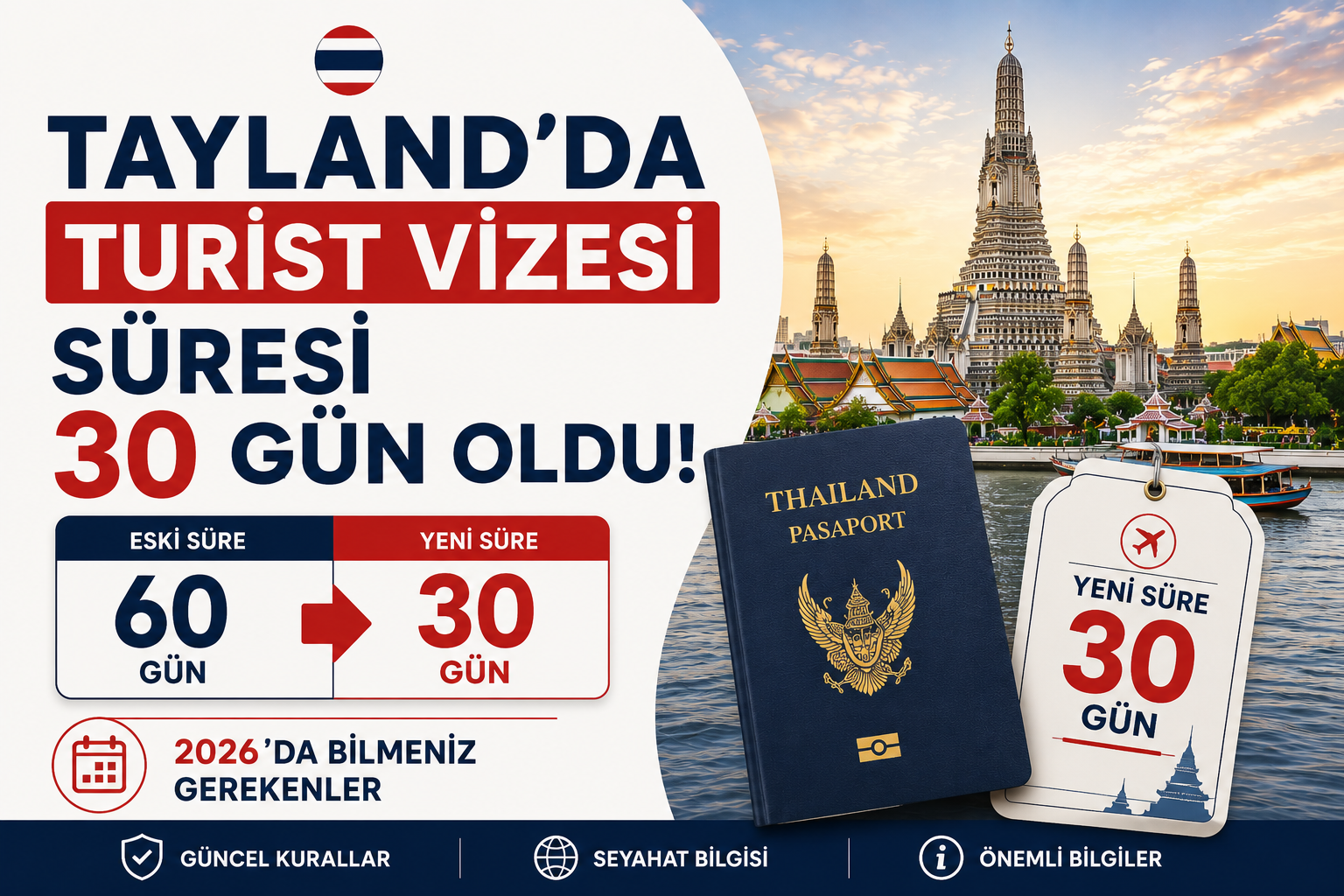
สารบัญ
The Cabinet approved this change on 19 May 2026. The new rules take effect 15 days after publication in the Royal Gazette, which has not yet been announced. Entries made before that date still benefit from the 60-day rule. Monitor thaievisa.go.th for the confirmed effective date.
What Changed — Quick Summary
In July 2024, Thailand doubled its visa-free stay from 30 to 60 days for nationals of 93 countries as part of a post-pandemic tourism recovery package. On 19 May 2026, the Thai Cabinet formally reversed that decision and reverted the limit back to 30 days.
| Rule | Before (2024–2026) | After (2026 onwards) |
|---|---|---|
| Visa-free stay | 60 days | 30 days |
| Countries affected | 93 countries | 93 countries (restructured) |
| In-country extension | +30 days at Immigration | +30 days at Immigration (1,900 THB, officer discretion) |
| Land border entries per year | Unlimited | Max. 2 times per calendar year |
| Visa on Arrival (VoA) countries | 31 countries | 4 countries |
| TDAC (Digital Arrival Card) | Mandatory from 1 May 2026 | Mandatory (continues) |
| Passport validity required | 6 months | 6 months (unchanged) |
Why Did Thailand Make This Change?
1. Visa Abuse
Thailand's Minister of Foreign Affairs, Sihasak Phuangketkeow, stated at a press briefing in Bangkok on 20 March 2026: "60 days may be too long and can create opportunities for individuals whose purpose is not tourism to remain in Thailand for extended periods, or even settle there." Authorities received reports — particularly from Phuket — of foreign nationals entering visa-free and engaging in undeclared work, operating informal businesses, and illegally subletting condominiums on short-term rental platforms.
2. Average Stay Is Only 9 Days
Government data shows the average foreign visitor stays approximately 9 days in Thailand — well below even the original 30-day limit. The ministry argues the change will have minimal impact on genuine tourists.
3. Declining Tourist Numbers & Revised Targets
Thailand revised its 2026 tourist arrival target from 35 million down to 32 million, following a 7% drop in 2025 and a further 3.4% decline in early 2026. The government is shifting focus from high volume to higher-spending, quality tourism.
4. Pressure from the Tourism Industry
The Association of Thai Travel Agents (ATTA) and the Thai Hotels Association had publicly raised concerns that the extended visa-free period was enabling illegal employment and unauthorized short-term rentals of condominium units — issues directly relevant to property markets like Pattaya.
Timeline: How We Got Here
Which Countries Are Affected?
30-Day Visa-Free Category (54 countries — down from 57)
The following nationalities previously enjoyed 60 days visa-free and will now be limited to 30 days: Australia, Austria, Bahrain, Belgium, Bhutan, Brunei, Canada, Czechia, Denmark, Estonia, Fiji, Finland, France, Georgia, Germany, Greece, Hungary, Iceland, Indonesia, Ireland, Israel, Italy, Japan, Jordan, Kuwait, Kyrgyzstan, Latvia, Liechtenstein, Lithuania, Luxembourg, Malaysia, Netherlands, New Zealand, Norway, Oman, Philippines, Poland, Portugal, Qatar, Romania, Saudi Arabia, Singapore, Slovakia, Slovenia, South Africa, Spain, Sweden, Switzerland, Taiwan, Turkey, Ukraine, United Arab Emirates, United Kingdom, United States.
Other Categories
| Category | Countries |
|---|---|
| 90 days visa-free (bilateral treaty) | Argentina, Brazil, Chile, Peru, South Korea |
| 30 days visa-free (separate protocol) | China, Hong Kong, Macau, Kazakhstan, Laos, Mongolia, Russia, Timor-Leste, Vietnam |
| 15 days visa-free (new category) | Seychelles, Maldives, Mauritius |
| 14 days visa-free (air arrivals only) | Myanmar, Cambodia |
| Visa on Arrival (reduced from 31 to 4) | Azerbaijan, Belarus, Serbia, India |
| ASEAN members (no change) | Malaysia, Brunei, Indonesia, Singapore |
What About Turkish Citizens?
Burgundy (standard) passport: Once the new rules take effect, the visa-free stay drops from 60 to 30 days. A single 30-day extension is available at any Thai Immigration office for 1,900 THB, bringing the total to 60 days. Approval is at the officer's discretion.
Green (official/service) passport: Turkey's bilateral diplomatic agreement grants 90 days of visa-free entry. This category is not expected to be affected by the current reform.
Is Visa on Arrival (VoA) Available for Turkish Citizens?
No. Turkish citizens have never been on the Visa on Arrival list. Turkey falls under the visa exemption category, meaning Turkish travelers pass directly through passport control without queuing or paying any fee. The reduction of VoA countries from 31 to 4 does not affect Turkish nationals.
Long-Stay Options for Turkish Travelers
| Option | Duration | Details |
|---|---|---|
| Visa-free + extension | 30 + 30 = 60 days | Apply at any Thai Immigration office; 1,900 THB; officer discretion |
| Tourist Visa (TR Visa) | 60 days (extendable) | Apply in advance at the Royal Thai Embassy in Ankara or Istanbul |
| Destination Thailand Visa (DTV) | 180 days + 180-day extension | For digital nomads & long-term visitors. Apply via e-Visa portal. Fee: 10,000 THB. Valid 5 years, 180 days per entry. |
| Retirement Visa (Non-Immigrant O-A) | 1 year, renewable annually | Age 50+. Requires 800,000 THB in a Thai bank or 65,000 THB/month pension. Health insurance mandatory. Employment strictly prohibited. |
| Education Visa (Non-Immigrant ED) | 90 days + 90-day extensions | For Ministry of Education-approved programs: language schools, universities, Muay Thai, culinary arts etc. 80% attendance required. |
| Non-Immigrant B (Business Visa) | 90 days + annual extension | For those establishing a company or working legally in Thailand |
One of the core reasons behind this policy change is the number of foreign nationals entering on tourist entries while pursuing other activities. Thai authorities are now enforcing this far more strictly. If you are coming to Thailand for any purpose other than tourism — business, long-term living, retirement, education, or investment — you must enter on the visa category that matches your actual purpose. Using the wrong visa category can result in denial of entry, blacklisting, or deportation.
Key Rules Under the New System
TDAC — Thailand Digital Arrival Card (Mandatory)
As of 1 May 2026, the paper TM.6 form has been abolished. All foreign nationals must complete digital arrival registration within 72 hours before departure. Registration is free. Official portal only: tdac.immigration.go.th. Beware of fraudulent websites charging fees.
Proof of Onward Travel
A confirmed outbound flight ticket is one of the most strictly enforced requirements. Airlines may deny boarding if you cannot present proof that you will leave Thailand within your permitted stay period.
Extension Is No Longer Automatic
Extending your 30-day stay requires a physical visit to a Thai Immigration office, payment of 1,900 THB, and an explanation of your reason for staying longer. Approval is entirely at the officer's discretion.
"One Country, One Visa Privilege" Principle
The reform is based on the principle of "one country, one Thai visa exemption privilege" — each nationality belongs to a single, clearly defined visa category, eliminating overlaps that previously existed for some countries.
Will Travelers Already in Thailand Be Affected?
Conclusion: A Shift in Thailand's Tourism Policy
This decision marks a clear pivot from Thailand's post-pandemic "open doors" approach toward a more controlled, quality-focused tourism model. The 60-day period successfully attracted visitors, but it also brought unintended consequences: undeclared work, tax avoidance, and violations of short-term rental regulations — issues that directly affect residential property markets in cities like Pattaya.
For short-stay tourists (7–14 days), this change is entirely inconsequential. The real impact falls on long-term visitors, digital nomads, and those coming to Thailand for investment, business, or retirement. For this group, proper visa planning before arrival is now essential.
At World of Condos, we provide our clients with up-to-date guidance on both property and visa-related matters in Pattaya. Contact us for personalized support.
Sources
- Bangkok Post — "Thailand ends 60-day visa-free stay" (19 May 2026): bangkokpost.com
- Al Jazeera — "Thailand to slash tourist visa-free stays" (May 2026): aljazeera.com
- Thailand NOW — "Thailand reverts back to 30-day visa-free scheme" (19 May 2026): thailandnow.in.th
- VisasNews — "Thailand's 60-day visa-free is ending" (19 May 2026): visasnews.com
- Nation Thailand: nationthailand.com
- TDAC Official Portal: tdac.immigration.go.th
- Thailand e-Visa Official Portal: thaievisa.go.th

WOC Media
"World of Condos Media" was created to bring the latest trends, investment opportunities and lifestyle tips in the world of housing to our readers.
มีคำถามเกี่ยวกับบทความนี้ไหม?
เขียนคำถามของคุณ แล้วผู้เชี่ยวชาญของเราจะติดต่อกลับโดยตรง





 Burak Pehlivan